Are there any other GPU companies besides Nvidia and AMD?
- Mar 17
- 12 min read
If you've ever shopped for a computer, you've seen the names: Nvidia and AMD. For decades, the graphics card market has felt like a two-horse race, the technology world's equivalent of Coke vs. Pepsi, dominated by the same graphics card brands. The constant buzz around these two giants makes it easy to assume they're the only players in the game. But with all the focus on this duo, is anyone else even competing? Are there any other GPU companies besides Nvidia and AMD?
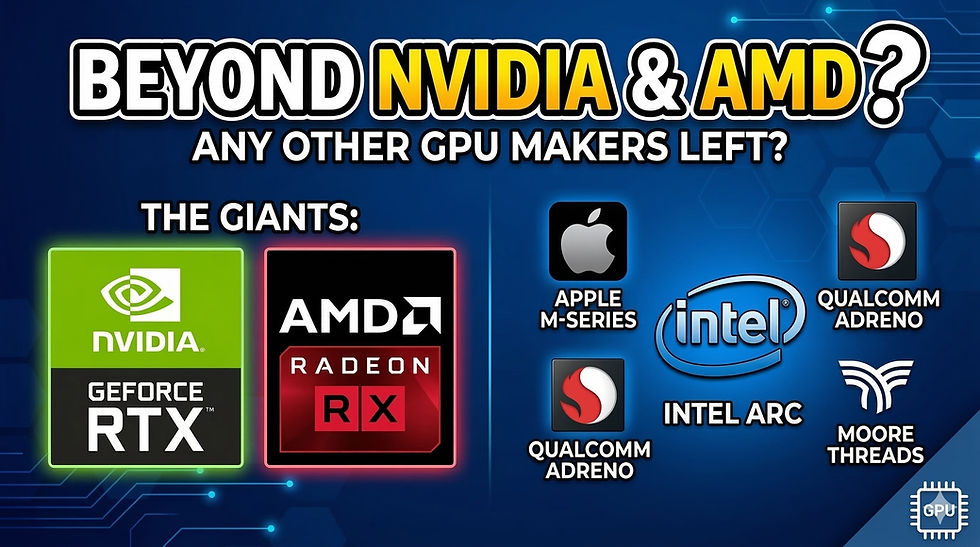
The answer is a surprising "yes," and their products are likely in devices you use every single day. Ever wonder what makes your smartphone screen so incredibly smooth or your car's dashboard display so crisp? The chips powering those visuals often come from a completely different set of gpu manufacturers that operate just beneath the surface of the high-profile PC market.
To understand this hidden world, it helps to know what a GPU, or Graphics Processing Unit, does. Think of it as a huge army of workers, perfect for tackling millions of small tasks at once---like coloring every single pixel on your screen. While Nvidia and AMD command the PC army, other giants command the ones in our pockets and on our roads. Let's take a look at these other players.
What's a GPU, Anyway? Your Computer's Secret Army of Artists
Every computer has a main brain, called the Central Processing Unit or CPU. You can think of it as a brilliant specialist, capable of solving incredibly complex problems, but it generally focuses on one major task at a time. It's the master of all trades, running your operating system and software with focused precision.
But what happens when the computer needs to do thousands of simple tasks all at once? That's where the Graphics Processing Unit, or GPU, comes in. Instead of a single genius, the GPU is like a massive army of workers. You can't ask any single worker to do something complicated, but you can ask all of them to each handle one tiny job, and together they can accomplish a huge project in an instant. In short, modern graphics processing units excel at massive parallel work.
This "army" approach is perfect for dealing with modern screens. Your phone or monitor is made of millions of tiny dots of light called pixels. To create a picture or play a video, the computer has to tell every single one of those pixels what color to be, changing them dozens of times per second. A CPU would be overwhelmed, but for a GPU, it's the perfect job for its army of workers.
The GPU's incredible ability to manage all these pixels is what creates the smooth video and stunning graphics we now take for granted. This raw visual power is especially critical for demanding video games, which is the main reason a two-horse race for the best graphics card began in the first place.
Why Do We Only Hear About Nvidia and AMD? The 20-Year Gaming Snowball
The dominance of Nvidia and AMD isn't an accident; it's the result of a snowball effect that started with PC gaming over two decades ago. It began as a simple loop: gamers wanted the best performance, so they bought the most powerful graphics cards available from the leading graphics card brands, which were made by Nvidia and AMD. Game developers, wanting to reach the largest audience, then focused all their effort on making their games run perfectly on those popular cards. This, in turn, made those cards the best choice for gaming, and the cycle repeated.
A huge part of this performance comes from a critical piece of software called a "driver." Think of the GPU as a powerful, high-tech engine. The driver is its unique instruction manual, telling your computer exactly how to use that engine to get the best results in every single application and game. Both Nvidia and AMD have spent years writing and constantly updating these complex manuals for their graphics processing units (GPUs).
Because these two companies have controlled the GPU market share for so long, game studios pour their resources into optimizing for their specific "manuals." It's simply not practical for them to also fine-tune their games for a tiny, unknown competitor from newer gpu manufacturers. As a result, even a technically good GPU from a new company might perform poorly simply because games aren't built to "speak its language."
This is why there are effectively only two major GPU companies for high-end PC gaming. A challenger doesn't just need to build a powerful chip; they have to overcome that 20-year snowball of game optimization and driver development. It's an enormous head start that has made the market a near-impenetrable duopoly.
The New Challenger: Is Intel's 'Arc' the Third Player We've Been Waiting For?
Breaking into a market so thoroughly dominated by two giants seems nearly impossible. Yet, a company you almost certainly recognize has decided to do just that: Intel. Known for decades as the leading maker of CPUs (the main "brain" of most computers), Intel has thrown its hat into the ring with its own line of graphics cards from a third gpu manufacturer.
This new line of products is called Intel Arc . Unlike the basic graphics capabilities that Intel has built into its CPUs for years, Arc cards are dedicated graphics processing units (GPUs). Think of it as moving from a decent all-in-one tool to a specialized, high-power instrument. These are separate, standalone cards you can buy, just like you would from Nvidia or AMD, designed specifically to handle demanding visual tasks like modern gaming.
Rather than trying to immediately topple the most expensive, top-of-the-line cards, Intel has taken a different approach. The first generation of Arc GPUs, like the Intel Arc A770, aims to be a compelling third option for everyday users and budget-conscious gamers from a third gpu manufacturer. By offering solid performance at a very competitive price, they are challenging the status quo and giving people a choice beyond the usual two brands.
The arrival of a serious new competitor is great news for everyone. Even if you remain loyal to Nvidia or AMD, the presence of Intel Arc forces all three companies to fight harder for your dollar. This increased competition can lead to better prices, faster innovation, and more options across the board. However, this isn't Intel's first foray into the world of graphics; they've just been playing a different game all along.
What's an "Integrated" GPU? The Graphics Chip You Didn't Know You Had
The fact that Intel has been involved with graphics for years might sound surprising, but it's because they are the masters of the most common type of GPU on the planet: the integrated one. Unlike a "dedicated" GPU, which is a separate, powerful card, an integrated GPU is built directly onto the same chip as the computer's main processor (the CPU). Think of it as a Swiss Army knife: instead of carrying a separate, specialized tool, the graphics capability is a handy feature included in the main package---the integrated graphics processing unit (GPU).
For the vast majority of computer tasks, this built-in approach is more than enough. Integrated graphics, like the "Intel HD Graphics" you might have seen listed on a laptop's specs, are incredibly power-efficient and perfectly capable of handling everything from browsing the web and streaming 4K video to managing your photo library. This distinction is key: you only need a power-hungry dedicated card for visually intense jobs like high-end gaming or professional 3D modeling. For everything else, the integrated chip works beautifully.
Because of this incredible efficiency, integrated GPUs (integrated graphics processing units) are the true workhorses of the computing world. They are in hundreds of millions of non-gaming laptops, office desktops, and all-in-one computers where cost and battery life are more important than raw gaming power. While dedicated cards from Nvidia and AMD get the spotlight, the humble integrated GPU is the unsung hero keeping most of the world's screens running. This idea of packing a tiny-yet-capable GPU into a larger system is even more critical in the devices we carry everywhere.
The Power in Your Pocket: Who Makes the GPU in Your Smartphone?
That concept of a tiny, efficient GPU built into a larger system is taken to the absolute extreme inside your smartphone. While Nvidia and AMD dominate the conversation around PC gaming, the world of mobile GPUs is run by a completely different set of technology giants. These companies design the sophisticated, power-sipping chips that render everything on your screen, from simple app animations to complex 3D games, all while fitting in the palm of your hand. In mobile devices, these GPUs are graphics processing units designed first and foremost for efficiency.
In the fierce battle for the smartphone market, three main players design the graphics chips that make your apps and games look so good:
Apple: Designs the powerful custom GPUs found inside every iPhone and iPad, a key reason for their famously smooth performance.
Qualcomm: Its "Adreno" line of mobile GPUs powers a huge number of high-end Android phones from brands like Samsung, Google, and OnePlus.
Arm: This British company designs the "Mali" GPU architecture, which is licensed and used by countless other manufacturers in a massive variety of Android phones and tablets.
These gpu manufacturers aren't just making smaller versions of desktop chips; they're designed with a completely different philosophy. Think of a big PC graphics card as a gas-guzzling muscle car, built for maximum speed above all else. A smartphone GPU, in contrast, is more like an advanced hybrid engine---it needs to be zippy and responsive, but its number one priority is incredible efficiency to make the battery last all day.
This relentless focus on balancing performance with low power consumption has made these mobile GPU designs some of the most sophisticated pieces of engineering on the planet. And their incredible efficiency has made them perfect for a whole new category of smart devices, from the dashboard of your car to the TV in your living room.
Beyond Phones and PCs: The Hidden GPUs in Your Car and TV
That incredible efficiency is exactly why these specialized graphics chips have quietly spread into countless other devices. The digital dashboard in a new car or the slick menu on a smart TV needs to be responsive and clear, but it also needs to be incredibly reliable and power-conscious. These aren't cards you can buy off a shelf; they are "embedded" GPUs, meaning they are built directly into the core electronics of the device, designed to do one job perfectly for years on end without needing updates or drawing much power.
While you'll find Arm's versatile designs in this space, it's also the primary territory of another major player you've likely never heard of: Imagination Technologies. For years, this UK-based company designed the GPUs for early iPhones before Apple began making its own. Today, their power-efficient graphics technology is a popular choice for the digital cockpits and infotainment systems in millions of cars from leading brands. Just like Arm, they don't sell a "graphics card" in a box; they license their designs to the big companies that build the final products, making them one of the most important invisible players in the industry.
The goals here are completely different from the PC gaming world. While a gamer might upgrade their graphics card every few years for more speed, a car manufacturer needs a chip that is certified to work flawlessly for over a decade. Reliability and efficiency trump raw power. This focus on stability over bleeding-edge performance has created a massive, parallel industry where companies like Imagination can thrive. It also helps explain what happened to the graphics companies of the past that tried---and failed---to keep up with the relentless pace of Nvidia and AMD.
Ghosts of Graphics Past: What Happened to Companies like 3dfx?
That relentless pace of development created a graveyard of once-mighty tech companies. While today's PC graphics market feels like a two-horse race, the 1990s were a chaotic battlefield, with a dozen competitors and graphics card brands such as Matrox, S3, and others all fighting for dominance. It was the Wild West of 3D graphics, but for a short, brilliant period, one company's name became legendary among PC gamers.
That legend was 3dfx Interactive. In the late '90s, their "Voodoo" graphics cards were revolutionary, transforming clunky, pixelated 3D games into the smooth, immersive experiences we expect today. For a time, they were the undisputed kings. But in the world of high-tech, sitting on the throne is a precarious position. A fiercely ambitious Nvidia innovated at a blistering pace, eventually surpassing 3dfx's technology and, in a final strategic move, acquiring the struggling company outright in the year 2000.
The dramatic rise and fall of 3dfx is the perfect example of market consolidation. Developing new graphics chips became a fantastically expensive arms race, and only companies with massive research budgets could afford to stay in the game. One by one, smaller players were either bought out or simply faded away. This intense war of innovation is precisely how the market was forged into the Nvidia and AMD duopoly we know in PC gaming today.
The New Gold Rush: How AI Is Shaking Up the GPU World
It turns out the same "army of workers" approach that makes GPUs perfect for graphics is also a perfect match for artificial intelligence. Training an AI, like the technology behind tools like ChatGPT, involves sifting through unimaginable amounts of data. This is a task that would overwhelm a single specialist CPU, but it's a simple job for a GPU's thousands of cores working in unison. This unique ability to process huge datasets in parallel has made graphics processing units the essential engine of the modern AI revolution.
For years, Nvidia saw this coming. While the public focus was on gaming, the company quietly invested billions in creating special software that made it easy for developers to use their GPUs for massive non-graphics calculations. This strategic head start paid off enormously. As a result, Nvidia's chips now dominate the huge computer centers that power the AI industry, a market that has become even more lucrative than PC gaming.
This AI gold rush has created an insatiable demand for powerful chips, shaking up the entire industry and attracting a new wave of emerging GPU companies . The immense profits have inspired startups and tech giants alike to design specialized chips just for AI. Furthermore, seeing the strategic importance of this technology, nations are getting involved. For instance, several Chinese gpu manufacturers are now racing to develop their own chips to compete on the world stage.
So, while the PC gaming world remains a familiar duel, a completely different---and far larger---battle is being waged for control of AI. This has effectively created two separate worlds for GPUs, each with its own leaders and rules. But when you look at the total market, who is actually winning? The answer reveals a very different picture of the GPU for AI landscape.
What's the GPU Market Share, Really? A Tale of Two Worlds
When you look at the high-performance graphics cards that gamers and creators buy for their PCs, the numbers are incredibly one-sided. For years, Nvidia has held a commanding lead, shipping roughly eight out of every ten dedicated GPUs sold. AMD consistently holds the distant second-place spot, while newcomer Intel is just starting to get its footing. In this highly visible arena---the one that gets all the headlines---it's clearly Nvidia's world among the best-known graphics card brands.
However, that's only looking at one specific neighborhood. If you zoom out to see the entire city---counting every single GPU in every device from smartphones to cars---the picture flips completely. In this massive global market, companies like Qualcomm (whose chips power most Android phones), Apple (with its custom iPhone and Mac silicon), and Arm (whose designs are used everywhere) ship a staggering volume of GPUs. Their numbers dwarf the PC graphics card market entirely, even though you rarely see their names on a sticker. Different gpu manufacturers lead in different segments.
This reveals the true nature of the industry: it's not one race, but many. Asking "who has the biggest market share" is misleading without asking, "in which market?" Nvidia dominates the high-profit PC and AI spaces, while Qualcomm and Apple rule the high-volume mobile world. Understanding this split is key, especially when trying to figure out what matters for your own needs. So, should your next laptop have an Nvidia, AMD, or Intel GPU?
So, Should My Next Laptop Have an Nvidia, AMD, or Intel GPU?
It's the most common question when buying a laptop, but the answer depends entirely on what you do. If your computer time is spent on web browsing, streaming videos, and writing emails, you don't need to worry. The standard, built-in graphics that come with most modern processors from Intel and AMD are more than powerful enough for all your daily tasks, saving you money for other features.
For those who want a bit more---perhaps for some light gaming or creative hobbies like photo editing---the landscape gets more interesting. This is the perfect territory for Intel Arc GPUs or the more affordable dedicated cards from Nvidia and AMD. These choices represent some of the best budget graphics card options, giving you a clear step up in visual performance without demanding a huge investment beyond the usual two graphics card brands.
What about serious, high-performance gaming? If you plan on playing the newest, most visually demanding titles with all the settings cranked up, your decision is straightforward. This is still the domain of high-end Nvidia and AMD GPUs. They are engineered specifically for that top-tier experience, delivering the raw power that hardcore gamers and creative professionals demand.
When buying a laptop GPU, the "best" brand is the one that matches your workload. The choice between Intel Arc vs Nvidia or AMD isn't about picking a team; it's about deciding what level of power you actually need. While these three battle for space on your desk, a completely different set of giants is powering the devices in your pocket.
The Hidden Giants: Why the GPU World Is Bigger Than You Think
The world of graphics cards no longer needs to feel like a simple two-company town. Where you once saw only the logos for Nvidia and AMD, you can now recognize the hidden players powering the screens you use every single day, from the phone in your pocket to the dashboard in your car. Your understanding of graphics cards has expanded beyond the PC aisle.
This reveals the simple secret to the GPU market: it isn't one big competition, but many separate ones. Nvidia and AMD dominate the exciting, high-profile race of PC gaming, which is why they get all the headlines. But in the enormous, quieter races for smartphones and cars, giants like Apple and Qualcomm are the champions. Across these categories, gpu manufacturers compete in very different ways.
Think of it less like a duel and more like the Olympics, with different events and different gold medalists for each one. Now, when you read about a new GPU, you can see past the hype and ask the one question that truly matters: "Which race are they running in?"


Comments