What Are the Leading Platforms for AI-Driven Creative Content Generation?
- Apr 16
- 13 min read
AI-driven creative content generation has transformed how businesses and creators produce written, visual, and video content. The leading platforms in 2026 include Jasper and Writer for long-form writing and brand governance, while Canva AI, Descript, and Synthesia dominate visual and video creation with integrated writing capabilities. These tools use generative AI to automate tasks that previously required significant time and specialized skills.
The market has evolved beyond simple text generators into comprehensive creative suites. You now have access to platforms that handle everything from blog posts and marketing copy to product images and promotional videos. Each tool brings distinct strengths, whether in content quality, ease of use, or integration with existing workflows.
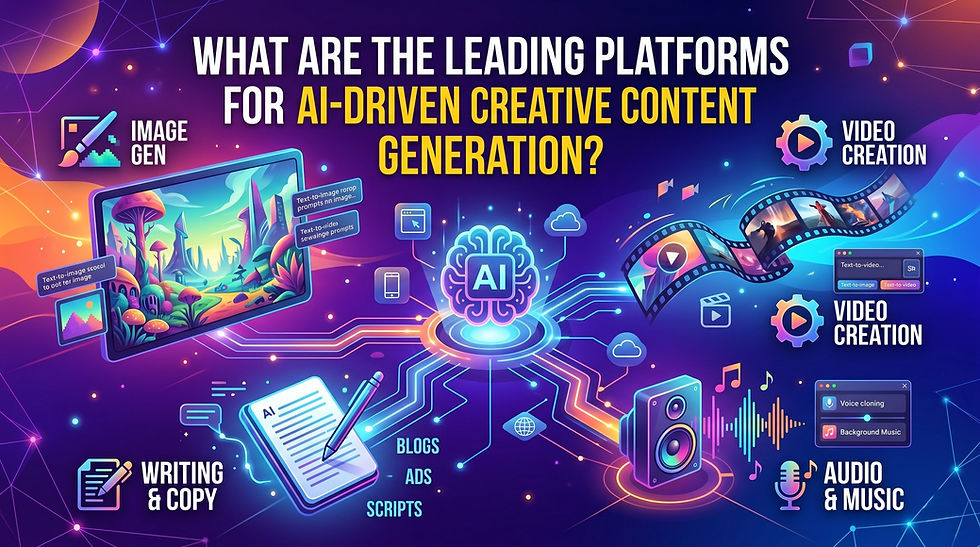
Choosing the right AI content generation tools depends on your specific needs and creative requirements. This guide examines how leading platforms perform across key dimensions including feature sets, output quality, workflow integration, and pricing models. You'll discover which solutions align best with different use cases and team sizes.
Top AI Platforms Powering Creative Content Generation
Several platforms have emerged as leaders in AI-driven content creation, each specializing in different aspects of the creative process. These tools combine advanced machine learning with user-friendly interfaces to deliver professional-grade content across text, visual design, and video production.
Jasper and Jasper AI: Advanced Writing and Brand Voice
Jasper AI stands out as a comprehensive writing platform built for marketers and content creators who need to maintain consistent brand voice across multiple channels. The platform uses large language models to generate blog posts, social media content, email campaigns, and product descriptions.
What sets Jasper apart is its brand voice customization feature. You can train the AI writer to match your specific tone, style, and messaging guidelines, ensuring output aligns with your brand identity. The platform includes templates for over 50 content types and supports content generation in more than 25 languages.
Jasper integrates with tools like Surfer SEO for optimization and includes a collaborative workspace where teams can review and refine AI-generated drafts. The Boss Mode feature enables long-form content creation with more control over structure and flow.
Canva and Canva AI: Visual Design Transformation
Canva has integrated AI capabilities throughout its design platform, making professional visual content creation accessible to users without formal design training. Magic Studio serves as the hub for Canva's AI-powered features, including Magic Design, which generates complete design layouts from simple text prompts or uploaded images.
The AI image generation tool within Canva lets you create custom graphics and illustrations directly in your design projects. Magic Design analyzes your content and brand assets to produce templates tailored to your specific needs. You can transform static designs into presentations or videos with automated formatting and transitions.
Canva AI also includes background removal, photo enhancement, and smart resizing for different platforms. The Magic Write feature generates text content within your designs, while the text-to-image functionality creates AI-generated images that match your creative vision.
Copy.ai and AI Writing Platforms for Automated Content
Copy.ai focuses on automating short-form content creation, particularly for marketing teams managing high-volume content needs. The platform excels at generating social media posts, ad copy, email subject lines, and product descriptions with minimal input required.
You can create content briefs, expand bullet points into full paragraphs, and generate multiple variations of the same message for A/B testing. Copy.ai includes workflow automation features that connect content creation to your broader marketing processes. The platform's template library covers specific use cases across industries and content types.
Recent updates have expanded Copy.ai's capabilities to include longer content formats and team collaboration features. The tool supports brand voice consistency through custom tone settings and style guides.
Synthesia and Runway ML: Video Creation and Realistic Avatars
Synthesia revolutionizes video production by enabling you to create professional videos using AI avatars instead of filming real actors. You type a script, select an avatar, and the platform generates AI avatar videos with realistic lip-syncing and natural movements. This approach eliminates filming costs, location constraints, and scheduling challenges.
The platform offers over 140 AI avatars representing diverse demographics and supports 120+ languages. You can create custom avatars based on real people with proper licensing. Synthesia includes templates for training videos, product demos, and corporate communications.
Runway ML takes a different approach to video creation, focusing on advanced editing and generation capabilities. The platform provides tools for background removal, object replacement, motion tracking, and frame interpolation. Its AI models can generate video from text descriptions or transform existing footage through style transfer and effects.
Runway ML appeals to creative professionals who need precise control over video elements. The platform includes Descript-like features for editing video by editing text transcripts, plus experimental tools for generating entirely new video sequences. Both platforms represent the shift toward accessible, AI-powered video production that previously required extensive technical expertise.
Key Features Differentiating Leading Tools
The most capable AI content platforms distinguish themselves through specialized features that address specific creative and operational needs. These tools combine brand consistency controls, cross-format generation capabilities, collaborative workflows, and performance optimization to deliver measurable business value.
Brand Voice Customization and Brand Kits
Leading platforms now offer sophisticated brand voice customization that goes beyond simple tone selection. You can upload existing content samples, style guides, and brand documentation to train AI models on your specific communication patterns. These brand kits store approved colors, fonts, logos, and messaging frameworks in centralized repositories.
Advanced platforms maintain brand governance through automated consistency checks. When you generate content, the system validates it against your established brand voice parameters and flags deviations. Some tools let you create multiple brand profiles for different product lines or customer segments.
Your team members can access shared brand kits to ensure all AI-generated content aligns with approved standards. This eliminates the back-and-forth revisions that occur when outputs don't match your established style guide.
Multimodal Generation: Text, Image, and Video
Modern content creation platforms integrate multiple AI models to handle text, images, and video within unified workflows. You can start with a text prompt and simultaneously generate written copy, complementary visuals, and short-form video scripts without switching between separate tools.
This multimodal approach compresses production timelines significantly. Rather than coordinating between writing teams, designers, and video editors, you can prototype complete content packages in minutes. The AI maintains thematic consistency across formats by referencing the same source inputs.
Platforms like Midjourney specialize in transforming text prompts into detailed visuals, while comprehensive solutions handle full content suites. You'll find that integrated platforms reduce the technical overhead of managing multiple specialized tools and vendor relationships.
Workflow Automation and Team Collaboration
Content workflow automation features streamline the path from content ideation to publication. You can set up automated approval chains, scheduling rules, and distribution protocols that reduce manual handoffs. AI-powered templates accelerate content planning by suggesting formats and structures based on your goals.
Team collaboration tools within these platforms include shared workspaces, commenting systems, and version control. Your content team can collaborate on AI-generated drafts simultaneously, tracking changes and maintaining edit histories. Some platforms integrate with project management systems to align content workflows with broader campaign timelines.
Automated content calendars sync with your team's bandwidth and publication schedules. The AI can suggest optimal posting times and content types based on historical performance data.
SEO Optimization and Content Scoring
Advanced platforms incorporate SEO optimization engines that analyze search intent and competitive landscapes. You receive content scoring based on keyword density, readability metrics, semantic relevance, and SERP analysis. The AI suggests specific improvements to increase search visibility.
Real-time SERP analysis shows how your content compares to ranking competitors. You can identify content gaps and opportunities before publishing. Some tools provide predictive rankings based on your content's optimization score relative to current search results.
Content scoring algorithms evaluate multiple factors including structure, meta descriptions, internal linking opportunities, and mobile readability. You get actionable feedback rather than generic suggestions, with specific word counts and keyword placements recommended for your target queries.
Evaluating Performance: Quality, Consistency, and User Experience
When selecting AI content generation platforms, evaluation requires examining brand governance capabilities, output realism, workflow efficiency, and verified user feedback. These factors determine whether a platform delivers production-ready content at scale.
Brand Consistency and Governance Controls
Brand governance features ensure AI-generated content aligns with your established guidelines and visual identity. Leading platforms provide customizable brand kits that include approved color palettes, fonts, logos, and tone specifications. These controls prevent off-brand outputs before they reach your approval stage.
Brand consistency mechanisms include style templates, automated brand guideline enforcement, and role-based permissions. You can restrict certain team members from accessing specific assets or modifying core brand elements. Some platforms offer AI model fine-tuning on your existing content library to learn your brand's unique aesthetic and voice patterns.
Advanced governance controls track content versions and maintain audit trails. This documentation proves valuable for compliance requirements and quality assurance reviews. You should prioritize platforms that allow you to set content parameters before generation rather than relying solely on post-generation editing.
Realism in AI-Generated Visual and Voice Content
Avatar realism has become a critical metric for video content platforms. Current generation systems produce digital avatars with natural eye movements, facial expressions, and lip synchronization. The gap between AI-generated and human-recorded video continues to narrow with improved rendering techniques.
AI voice cloning technology now replicates vocal characteristics including pitch, tone, accent, and speaking pace. Premium platforms offer studio sound quality that eliminates background noise and maintains consistent audio levels across generated content. Some services require only 30-60 seconds of voice samples to create convincing clones.
Voice cloning quality varies significantly between providers. Evaluate platforms based on emotional range, pronunciation accuracy of technical terms, and naturalness in longer-form content. Lower-quality systems exhibit robotic cadence or struggle with complex sentence structures.
Visual realism extends beyond avatars to image and video generation. Examine how platforms handle challenging elements like human hands, text rendering within images, and consistent object physics across video frames.
Approval Workflows and Content Optimization
Approval workflows streamline collaboration between content creators, brand managers, and legal teams. Multi-stage review processes allow stakeholders to comment, request revisions, and approve content without leaving the platform. You can configure automated routing based on content type, distribution channel, or risk level.
Content optimization features analyze generated outputs against performance benchmarks. AI systems suggest improvements for readability, SEO effectiveness, or engagement metrics based on your historical data. Some platforms A/B test variations automatically to identify top-performing versions.
Version control systems track every iteration and modification. You can revert to previous versions or compare changes between team members' edits. Integration with project management tools ensures content production aligns with campaign timelines and publishing schedules.
User Reviews and G2 Rankings
G2 provides verified user reviews that reveal platform strengths and limitations in real-world applications. Pay attention to reviews from companies in your industry or with similar content volumes. User reviews often highlight issues not apparent during trial periods, such as customer support responsiveness or pricing transparency.
E-E-A-T considerations matter when evaluating reviewer credibility. Look for detailed reviews from verified purchasers who describe specific use cases and results. Generic positive reviews without concrete examples provide limited value for your decision-making process.
Rating distributions reveal important patterns. A platform with mostly 5-star and 1-star reviews suggests inconsistent performance or steep learning curves. Compare ease-of-use scores across different user expertise levels to gauge whether the platform matches your team's technical capabilities.
Integrations and Workflow Management in Modern AI Creative Stacks
AI content creation platforms deliver maximum value when connected to existing marketing infrastructure. The ability to move content seamlessly from generation to publication, while maintaining brand consistency and approval workflows, separates enterprise-grade solutions from standalone tools.
Content Automation and CMS Integration
Content management systems serve as the central hub for publishing workflows, making CMS integration essential for scaling AI content production. Most AI content creation platforms now offer native connectors to WordPress, allowing you to generate articles, optimize metadata, and publish directly without manual copying. Webflow and Contentful integrations enable headless CMS architectures where AI-generated content populates dynamic templates across multiple channels.
Content automation extends beyond basic publishing. Advanced platforms can trigger content generation based on inventory changes, news events, or seasonal trends detected in your analytics. You can set rules that automatically generate product descriptions when new SKUs enter your database or create social variants when blog posts publish.
API-first architectures let technical teams build custom integrations with proprietary content management systems. These connections often include version control, multi-language support, and asset management that keeps images and copy synchronized across platforms.
Marketing Automation and Social Media Management
Social media management requires coordinating content across platforms with different format requirements and audience behaviors. AI tools integrate with Buffer, Hootsuite, and Sprout Social to automatically resize images, adjust copy length, and schedule posts based on engagement patterns. The workflow typically starts with AI generation, moves through approval queues, and ends with platform-specific optimization.
Marketing automation platforms like HubSpot, Marketo, and Salesforce Marketing Cloud connect AI content tools to broader campaign orchestration. You can generate email variants for A/B testing, personalize landing page copy based on visitor segments, and create nurture sequences that adapt messaging to user behavior. These integrations track which AI-generated content drives conversions, feeding performance data back into the generation process.
Cross-platform analytics become crucial when managing AI content at scale. Integrated dashboards show how AI-generated social posts perform compared to human-created content, which topics resonate with different audiences, and where your creative workflow bottlenecks occur.
Prompt Engineering and AI Agents
Prompt engineering transforms AI content tools from one-off generators into reliable production systems. You can save prompt templates that include brand voice guidelines, target keyword density, and structural requirements that ensure consistent output. Advanced platforms let you chain prompts together, where one AI agent researches topics, another creates outlines, and a third writes final copy.
AI agents operate as autonomous workers within your creative workflow. You might deploy an agent that monitors competitor content and suggests response articles, or one that analyzes your top-performing posts and generates similar variants. These agents access your content library, understand your style guide, and make decisions within parameters you define.
The integration layer manages context between AI agents and your existing tools. When an agent identifies a content opportunity, it can create tasks in project management software, pull relevant data from analytics platforms, and queue drafts in your editorial calendar without human intervention.
CMS and HubSpot Content Hub Connectivity
HubSpot Content Hub represents the convergence of CMS integration and marketing automation for AI-driven workflows. The platform connects AI content generation directly to your CRM data, enabling personalization based on contact properties, lifecycle stage, and engagement history. You can generate blog posts optimized for specific buyer personas, create landing page variants for different industries, and build email campaigns that reference actual customer data.
The Smart Content feature works alongside AI tools to display different copy based on device type, country, or list membership. This creates a feedback loop where AI generates multiple variants and HubSpot's testing framework identifies winners. Content performance metrics flow back into your AI platform, training future generations on what actually converts your audience.
Workflow automation in HubSpot triggers AI content creation based on campaign milestones. When a contact reaches a specific score threshold, the system can generate personalized follow-up content. When a deal enters a new stage, AI creates customized case studies or proposal sections that sales teams can immediately use.
Pricing, Scalability, and Enterprise Applications
AI content platforms employ diverse pricing models ranging from per-user subscriptions to token-based consumption, with enterprise tiers offering advanced governance features. The best AI content creation platforms distinguish themselves through flexible scaling options and integrated compliance tools.
Enterprise Pricing Structures
Enterprise pricing for AI content platforms typically follows one of three models: per-seat licensing, consumption-based billing, or hybrid approaches. Most platforms reserve advanced features like API access, custom model training, and dedicated support for enterprise tiers priced between $500 and $5,000 monthly.
Volume discounts become available when your organization requires multiple seats or generates significant content throughput. Some providers charge based on output tokens or generation credits rather than flat rates, which can benefit teams with fluctuating content needs.
Contract terms for enterprise accounts usually span 12 to 36 months with negotiable provisions for data retention, service level agreements, and security compliance. Many best AI tools for content creation now offer trial periods for enterprise features, allowing you to evaluate capabilities before committing to annual contracts.
Scalability for Teams of All Sizes
Small teams can start with basic tiers offering 3-5 user seats and upgrade as requirements expand. Mid-sized organizations benefit from collaborative workspaces that support 10-50 users with shared asset libraries and workflow templates.
Enterprise deployments scale to hundreds or thousands of users through role-based access controls and departmental segmentation. The best AI content creation platforms provide centralized billing, usage analytics, and admin dashboards that track content generation across your organization.
API integrations allow you to connect AI content platforms with existing content management systems, enabling automated workflows at scale. Cloud infrastructure ensures performance remains consistent whether your team generates 100 or 100,000 assets monthly.
Plagiarism Checking and Content Governance
Built-in plagiarism checkers scan generated content against billions of web pages and published materials to identify potential duplication. These tools flag similarity percentages and highlight matching passages, protecting your organization from copyright issues.
Content governance features include brand guideline enforcement, tone consistency checks, and approval workflows. You can establish mandatory review processes before content reaches publication, with version control tracking all modifications.
Enterprise AI content platforms integrate with compliance frameworks for regulated industries, maintaining audit trails of all generated materials. Custom filtering prevents generation of inappropriate content while style guides ensure outputs align with your brand voice across all teams and projects.
The Future of AI Creative Content Workflows
AI content generation is shifting from single-purpose tools to integrated ecosystems that handle end-to-end production. Advances in multimodal capabilities, agentic collaboration, and long-context processing are redefining how you plan, create, and distribute content across channels.
Emerging AI Models and Multimodal Capabilities
GPT-4o, Claude, and Gemini represent a new generation of AI models built for multimodal tasks. These systems process text, images, and code within a single workflow, letting you generate written drafts alongside visual assets without switching platforms.
OpenAI's GPT-4o and Anthropic's Claude offer extended context windows that maintain coherence across longer documents. You can now feed entire brand guidelines, previous campaign materials, and reference documents into a single prompt for more consistent output.
Gemini's native multimodal architecture allows simultaneous reasoning across different content types. This means you can describe a concept and receive coordinated text, image suggestions, and layout variations in one interaction. AI image generators are incorporating style reference locking and batch processing, giving you repeatable visual outputs that match brand standards without manual adjustments for each asset.
Agentic Systems and Real-Time Collaboration
AI workflows are becoming autonomous agents that execute multi-step tasks without constant oversight. You set parameters and goals, then the system handles research, drafting, revision cycles, and format adaptation.
Node-based workflow automation lets you chain together AI writing, visual content generation, and approval processes. Your team can trigger a single workflow that produces blog posts, social media graphics, and email variants from a brief.
Real-time collaboration features now allow multiple team members and AI agents to work on the same project simultaneously. Version control and approval tracking integrate directly into creative automation platforms, reducing the time between concept and publication. These systems learn from your edits and preferences, gradually requiring less human intervention for routine content tasks.
AI for Long-Form and Multichannel Content
Long-form content creation has improved significantly with models trained specifically for sustained coherence. You can now generate white papers, case studies, and comprehensive guides that maintain narrative consistency across 5,000+ words.
AI video generation tools are expanding beyond short clips to produce edited sequences with transitions, text overlays, and audio synchronization. Platforms supporting video content creation now offer templates that automatically adapt your existing written content into video scripts and visual storyboards.
Multichannel optimization features analyze your source content and automatically generate platform-specific variations. A single long-form article can become LinkedIn posts, Twitter threads, Instagram carousels, and YouTube scripts through AI-driven reformatting that preserves core messaging while adapting tone and length.
Market Growth and Strategic Adoption
Organizations are consolidating fragmented toolsets into unified AI content generation platforms. In-house marketing teams and content agencies prioritize systems that reduce vendor sprawl while increasing output volume.
Growth-stage companies use creative automation platforms to scale content production without expanding headcount. These tools deliver cost efficiency by automating repetitive design and copywriting tasks that previously required specialized staff.
The shift toward end-to-end content ecosystems reflects demand for platforms that brainstorm, research, draft, visualize, and optimize performance in one environment. You'll see increased focus on platforms offering built-in analytics that connect content generation directly to performance metrics, letting you iterate based on what actually drives engagement and conversions.


Comments